

WONDERSTATE COFFEE SNAPSHOT
|
Industry |
Manufacturing/retailer
|
|
Revenue |
$9 million
|
|
Staff size and/or projected |
82 total staff members, roughly half are full time
|
|
Year of origin |
2005
|
|
Headquarters |
Viroqua
|
|
Number of customers/ |
Approximately 400 wholesale accounts
|
|
Revenue sources |
Online, wholesale, cafes
|
|
Business |
S-Corp. with B-Corp. certification
|
Wonderstate’s high-quality coffee and its close relationship with growers in South America and other parts of the world have distinguished this Viroqua business for two decades.
To emphasize such connections, Wonderstate Coffee co-owner TJ Semanchin points to a giant rolldown map — the sort often seen in school classrooms — highlighting the farmers and farm cooperatives that grow the beans, which the company then roasts in this rural pocket of Wisconsin.
Wonderstate prides itself on sustainable business practices. It became one of the first 100% solar-powered coffee roasteries in the world in 2015 and was the first company to win Roast Magazine’s Roaster of the Year twice. It has a mission to support farmers and small businesses by paying above the fair trade price of coffee, and it gives back 5% of profits to support land conservation, the LGBTQ+ community and revitalizing the Ojibwe language.
The company has been steadily growing. Over a decade ago, Wonderstate roasted around 100,000 pounds of coffee beans per year; now the company roasts about 450,000 and expects to roast 500,000 this year.
Madison is one of its largest wholesale markets, with Minneapolis also a major market. Most of Wonderstate’s wholesale customers are in the Upper Midwest, split between Wisconsin, Minnesota, Iowa and Illinois. The company has about 400 wholesale accounts, selling beans to about 12 different states.
Direct online sales account for 17% of total revenue, which Wonderstate co-owner Caleb Nicholes calls a “really, really healthy online business.”
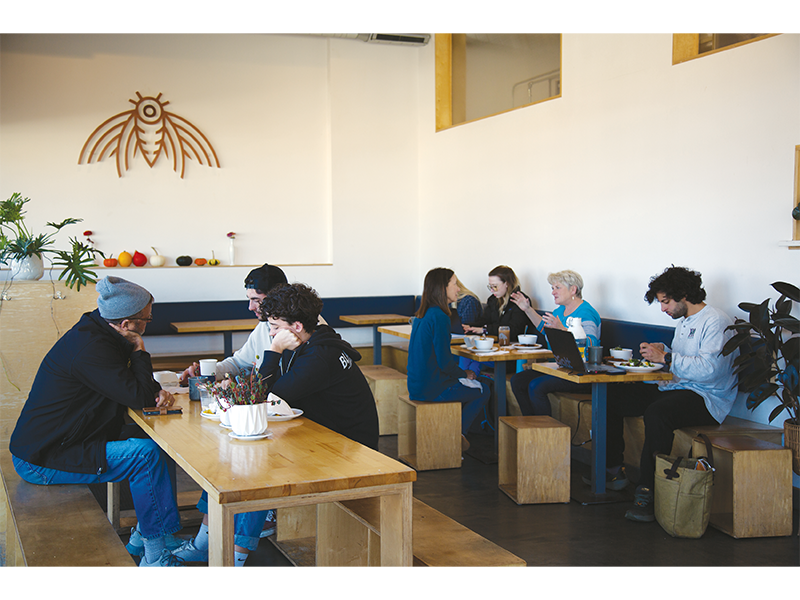
It also has its own cafes on Madison’s Capitol Square, in Bayfield and Viroqua.
Wonderstate’s approach is to build long-lasting relationships with farmers, paying well over the commodity price for coffee. That said, coffee prices are soaring. One of the largest producers, Brazil, recently had a 50% tariff added to the price of coffee beans shipped to the United States. In mid-November, it was lowered slightly to 40%.
In grocery stores, coffee beans cost $9.14 per pound in September, up from $8.87 in August, and a 41% jump from September 2024, according to data from the U.S. Bureau of Labor Statistics.
Rising prices, tariffs and economic uncertainty are harming companies like Wonderstate, its executives say. Still, Wonderstate is committed to doing business its way, becoming a Certified B Corporation in October, a confirmation of high standards, implementing a profit-sharing program with non-leadership staff in 2024 and continuing to pay its farmers above the average.
Origin story
Wonderstate is a part of the bucolic Vernon County agricultural community — including Organic Valley, the largest organic farming co-op in North America.
Semanchin and Nicholes fired up their first roast in 2005 when Wonderstate was known as Kickapoo Coffee. They named it after the nearby Kickapoo River before they learned of the Kickapoo Native American tribe.
Money, time and an established brand were then transformed into Wonderstate in 2020.
In those early days, Semanchin, his wife Denise and Nicholes were all mulling a coffee roasting business.
Nicholes worked as a wine importer in Madison, but was ready for a change.
As a home coffee bean roaster, he opted to pursue it professionally. Meanwhile, Semanchin and his wife were thinking about leaving Minneapolis.
“We were looking to start a roastery here in Viroqua at the same time Caleb was, and so as we caught wind of him starting up this enterprise through mutual friends… we just came in and introduced ourselves, and we decided to join forces right away,” Semanchin said.
Nicholes and Semanchin bring different backgrounds to the business. Nicholes focuses on the qualitative and sensory aspects of coffee, stemming from his wine experience.
Semanchin spent time living and traveling in Latin America studying issues around sustainability.
“I come more from the organic and fair trade side of the coffee world,” he said. “Our two backgrounds… are really at the core of what we were trying to do in 2005. At the time, there was a big debate within the coffee industry between… folks who were more focused on the mission of supporting small farmers and those who were more focused on quality and the unique flavor aspect.”
Semanchin said to this day, Wonderstate exists within both worlds, and buys beans from farmers they’ve worked with for over 20 years.
“A really critical component of growth for us is being able to do what we set out to do better, to go deeper with our mission,” Semanchin said.
The process
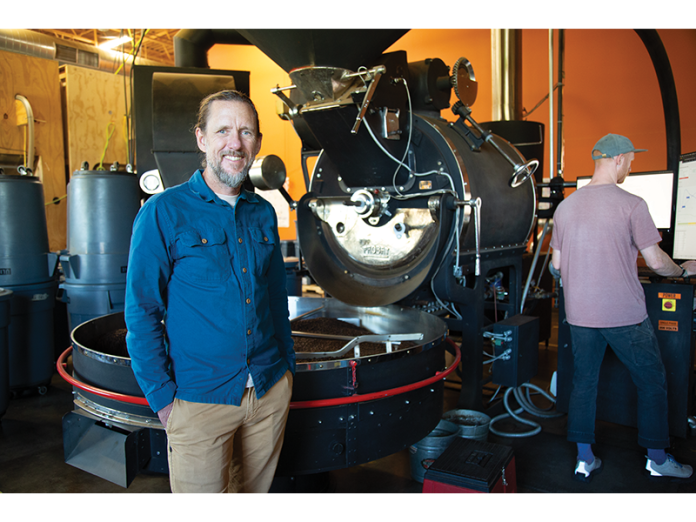
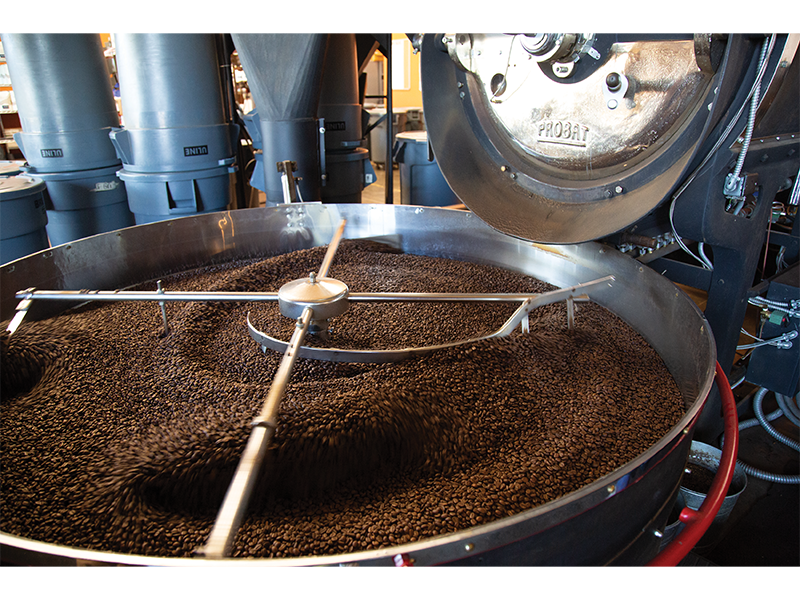
At its roastery in Viroqua, two large, German-made cast-iron machines whirl, crank and absorb and transfer heat consistently into green coffee beans, bringing out rich flavors.
These Probat roasters are old, hailing from the 1930s and 1950s, sometimes fussy, and outfitted with modern technology to ensure accurate roasting temperatures. The initial high-tech equipment Nicholes purchased was not designed well, he said, and broke down.
But these two Probats, which he found while researching what specialty coffee roasters were using during their nascent stages, proved profound.
“One of the things that makes them so great is just the amount of cast iron construction on them, so the way that they hold heat and radiate heat into the coffee is very predictable,” Nicholes said. “The radiant heat really does develop the coffee in a unique way.”
Like fine wine
Nicholes leads the team in a tasting process called cupping. Tiny glass jars of coffee beans can be found stashed all around Wonderstate’s offices.
Coffee is roasted to a specific light color. Nicholes likens it to a steak, where different levels of roast, like a rare or medium steak, hold different flavors.
From there, the analysis begins. Cups get a specific measurement of coffee. The coffee is sniffed while dry. Boiling water is then added. Once wet, the “wet” aroma is evaluated, before it is evaluated again at about 15 minutes after the coffee has settled and clarified.
Then sipping with a spoon begins. It is essential to taste it at nearly room temperature, as Nicholes said, that is when senses can most ascertain flavor.
The coffee is scored throughout, and the team may note if any defects or inconsistencies were noticed between cups. Moisture meter reads determine roasting time and temperature to ensure best flavor and shelf stability.
“It’s hard to do consistently well,” Nicholes said.
And there are climate challenges, he said. “We live in the Midwest, and humidity is changing throughout the year, and so those things also impact the way that the coffee develops, just like your baking. So it’s really important to have excellent processes behind each batch.”
Cost realities
In 2017, Wonderstate began paying a minimum price to coffee growers.
At the time, they paid $2.75 per pound, about 60% above the fair trade price, and Wonderstate committed to raising that price a nickel per year, Semanchin said. He said fair trade coffee price standards don’t adjust often, while farmers deal with increasing costs, inflation and more.
The minimum price Wonderstate paid for coffee in 2024 is $3 to $3.15, Semanchin said.
But then there is market volatility.
“Everything I just said about our minimum price right now in today’s market is kind of out the window,” Semanchin said. “The price of coffee has almost doubled in the last few years.”
Now, he said, Wonderstate pays over $5 per pound for coffee, before tariffs. Depending on the country, tariffs can add another 10% to 40%.
“Before we even get the coffee, we pay the tariff bill, which is astronomical,” he said. “It’s killing us as a small business. It’s destroying our potential for profit and investing in our company and our employees. It’s a huge tax on small businesses. That’s our reality today.”
And, as a business offering robust health care options to employees, Semanchin and his team have been looking at an increase in health care costs by 70%.
“We provide health care for everyone in this building — yeah, it’s staggering,” he said.
Semanchin is a part of the Main Street Alliance, a network of 30,000 small business owners trying to level the playing field in Washington, D.C., so small local businesses can thrive. He advocates for better policy, but admits there is only so much small businesses can do. But he’s trying.
“Those are issues that I’m intimately involved with, and care about and I’m recognizing I can’t fix these internally — we can do what we can,” Semanchin said.
Accolades add up
While challenges aren’t letting up any time soon, Wonderstate continues to have enthusiastic support from local shops that serve its coffees.
“We love Wonderstate,” said Evan Grobarchik, manager of Java Den, 1022 W. Johnson St., noting that the coffee shop has worked with the coffee roaster since Java Den opened.
“One of our favorite things is how sustainable they are and how environmentally conscious they are,” he said, pointing to its use of solar power, among other practices. “They really care about their product and try to put the best beans out there.”
He said he did a cupping with Wonderstate a couple of years ago — smelling and tasting about 20 roasts — to produce its own Java Den blend.
He said Java Den’s baristas will be touring the Wonderstate roastery in January to learn more.
Broken Board Coffee at 2358 East Springs Drive also regularly serves Wonderstate coffee.
“We use Wonderstate as our house roaster simply because they’re one of, if not the best, in the state,” said Jared Kist, owner of Broken Board.
“They have a well-selected variety of high-quality coffee, they roast it carefully to preserve the characteristics of the origin, they do it consistently and they have long-term commitments to the farms that produce the coffee they roast,” he said.
In October, two Wonderstate staff members were in Peru meeting with a producer group. Cultivating such relationships enables the company and farmers to grow their businesses.
“We’re buying volume and quality and making as much impact,” Semanchin said. Which, in turn, helps farmers develop farms and produce better-quality coffee that Wonderstate pays higher prices for.
Wonderstate does not want homogeneity, but uniqueness. In spite of the hurdles it faces, the Viroqua roaster is set on cultivating a better way to lead, one roast at a time.

