
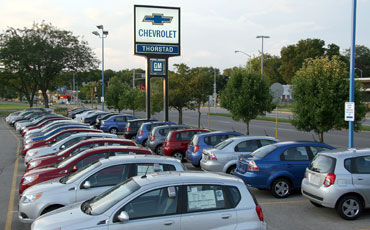

There still is a sliver of a chance that Thorstad Chevrolet will remain a General Motors dealer, but the company is realistically proceeding with plans to sell used cars when its GM contract expires in 2010. That sliver of hope comes in the form of Congressional legislation that would prevent the shutdown of thousands of dealerships nationwide, which has brought GM to the table to work out a compromise on dealer closings.
Ron Thorstad, president of the family-run dealership, doesn’t really have a read on the machinations in Washington, D.C., so he’s hardly in a position to place odds on whether his dealership will be restored. “I don’t know,” he stated. “We’re going to have an awful lot of I don’t knows in this conversation.”
He does know that even though the 44-year-old dealership has sold both new and used cars for many years, the business challenges associated with this change are not trivial.
They start with leveraging what Thorstad called “arguably the finest parts and service operation in the Midwest.” The challenge: getting a big enough chunk of the local service business for any model of vehicle, not exclusively GMs.
“A major challenge will be that, of course, people will come here for service,” he said, “but eventually they will buy a new vehicle, and they will return to wherever they bought the vehicle for warranty, and those dealers will court the ongoing service business.”
With 28,000-square-feet of inventory space, the Thorstad dealership, located on Park Street, has served as a mini-warehouse for GM parts for southern Wisconsin. Many other GM dealers that don’t have a large inventory come to Thorstad to buy parts because there is a good chance they will find them.
“The problem we’re going to have when we’re no longer a GM dealer, I should say if we’re no longer a GM dealer, is getting the correct GM parts because there is going to be no Thorstad Chevrolet to go to in order to get them. We’ll be in the same position as everyone else in the southern part of the state. We’ll have to order them probably from another Chevrolet dealership, who will then not have them in inventory, so then they’ll have to go and order them from General Motors.”
Then, he said something truly stunning about the car manufacturer that wants to cut him loose. “I don’t think General Motors has any awareness of the importance of the parts and service business, and how it’s going to affect their reputation,” he said.
Thorstad, who describes the dealership as a large mom-and-pop store, is not without assets. In the five weeks following GM’s bankruptcy plan was announced, not one of the dealership’s 105 employees has left for greener pastures, real or imagined. Unfortunately, the transition to used cars will require some downsizing.
“It’s sort of like family working here,” he said. “That’s why we haven’t had anybody leave yet. When it comes time for the downsizing, it will be very painful.”
On the plus side, Thorstad has no doubts the dealership can move used vehicles. Out of loyalty to GM, Thorstad Chevrolet has never displayed its used vehicles on Park Street, where the daily traffic count has reached 25,000 cars. When the used vehicles are placed there, he expects them to have much better exposure and sell at a faster clip.
The fact that the dealership has a solid reputation in the sales and service realms, mitigates any lingering stigma attached to used-car dealers, a stigma that Thorstad believes is long gone. That reputation, however, “has to be earned on an on-going basis, but I think that’s our nature and it will occur,” he said.
In terms of pure used-car sales, Thorstad agreed that it would be a fairly smooth transition — “We’re just going to have to increase the magnitude” — and he has no preference for the makes and models sold. He does, however, have certain criteria for the type of used car that Thorstad will offer. “It has to be something of value to a customer, and that covers a wide range,” he said. “It would be nice to have every vehicle 5,000 miles or less, in pristine condition, but then you’ve taken an awful lot of people who are in the used car market and you’ve excluded them because they can’t afford that. So there is a place for vehicles of considerably less quality, as long as you’re providing a true value to the person buying the car for what they are paying for it.”
Asked if he has any concern about running a used-car dealership in the “green car” era, especially in an environmentally conscious community like Madison, his answer was indicative of a man who knows how to respond to consumer tastes. “Whatever the public is buying will, in a relatively short time, become available in the used market,” he noted. “If that’s what the public is buying, then that’s what any used-car lot would be selling.”
Does that include the Toyota Prius and other hybrid models? “Um hmmm,” he agreed, “all of those.”
For the same reason, he does not believe the lack of a dealer affiliation will put the Thorstad dealership behind the curve when future innovations like the hydrogen-powered car finally become commercially viable. “No, because at such time they get that, within less than a year, that will be available on the used-car market,” he said.
The sources for Thorstad’s stock of used cars will include auctions, which are held all over the country, trade-ins, and simply beating the bushes for value. The Internet provides access into auctions nationwide, enabling dealerships to buy what they need to balance their inventories, and car buyers “just stay on the road and travel around from place to place and they buy vehicles from dealerships or from fleets,” he said.
On whether there is an age limit for used cars that Thorstad would buy, Thorstad said there probably is, but he doesn’t know offhand what that limit would be. Five years sounds reasonable to him, but it depends on the vehicle’s condition. Preparing used cars for sale is a cost of doing business, especially in Wisconsin, which has very strict laws on the condition of used vehicles that are sold by dealerships.
Thorstad also commented on the extent to which his family is planning this transition while there is still a glimmer of hope that Thorstad can keep the GM dealership: “It’s a good question. I don’t know,” he said. “We will, as we proceed through this year, have a better and better feel.”
At the moment, Thorstad Chevrolet has well in excess of 100 new vehicles still to sell, and will likely sell them inexpensively because it does not want to have new vehicles and then lose the franchise. That would make them very hard to sell, he said, so Thorstad is selling the new vehicles at a loss.
“As we get down with a lower and lower amount of new vehicles, then we’ll begin to get a feel for what this place would be like without having new vehicle sales,” Thorstad said. “Until that happens, I just can’t tell you.”
Thorstad will continue to honor warranties on new cars sold between now and the contract expiration; beyond that, it depends on GM. “We’re still honoring them,” he said. “Now did you say after we’re done with the new cars? A General Motors warranty, no. The new vehicles that we sell will have the full General Motors warranty. How long General Motors will allow us to continue servicing that warranty will be the question.”
He anticipates higher training costs for mechanics that eventually will be asked to service a more diverse mix of makes and models. “There probably will be,” he acknowledged. “You have to understand that what I refer to, it’s kind of a corny name, ‘world-class technician,’ but that was the name General Motors assigned to the very highest capable technicians in the country. We have always had high training costs for mechanics because that’s our nature. We’re not awed by having to train as we go forward, and training is a lot easier now in the age of computers.”
Thorstad Tidbits
On whether the nation would have been better off if the federal government had simply tried to help the car makers by sending a check to every consumer under a certain income threshold for the purpose of buying a new American car: “Damned if I know. It would be a fascinating thing to think about. What criteria would you put on it? Would you have a certain gas mileage requirement that they would go by? If you’re trying to save GM and Chrysler and, at that time, we all thought Ford, do you restrict it … and then what happens to all those legislators in all those states in the south that make the imported cars? I think it would be chaotic. I can’t imagine that happening.”
On the general perception that American car companies had too many labor commitments and legacy costs to compete with their Japanese counterparts, and that’s why they were in so much trouble: “I think that the legacy costs are a giant part of the problem they had. Now, when you go to assess blame, and everybody tends to do that, you can’t blame the unions. The union leaders are doing what they are paid to do. If you want to blame somebody, blame the management who gave into him or her year after year after year. There is an outstanding book on the subject that’s long out of print called, The Company and the Union [The Company and the Union: The Civilized Relationship of the General Motors Corporation and the United Automobile Workers]. It’s a description of the 1970 strike against General Motors, written by a reporter [William Serrin] from the Detroit Free Press, who I’m told is now a professor for New York University.
“General Motors, at that time, was so strong that had they stood up to the union, it would have been the shortest strike on record. They walked, some 400,000 GM employees; GM kept 200,000 working rather than close the shop, making parts for Ford and Chrysler. Had they said, ‘you 400,000, now you’re all going to be on the street,’ the union could not have sustained even paying union dues, wages, for probably two weeks. It would have been all over, but GM kept them going. GM loaned the UAW money to keep health benefit payments going. I don’t fault the union for this at all. I fault management for never standing up to unions.
“I also never fault management for being dumb in other areas. When they came out with Saturn, they claimed that that was going to be the big import fighter. As we looked at registration lists following Saturn’s introduction, where all the people who had been buying Chevrolets and Pontiacs, it did not accomplish what they were after as an import fighter. Saturn lost money every year except one, and the answer to Saturn is that they came out with Hummer, which nobody ever in the business thought had a prayer of breaking them. So these are not wise things.”
On the philanthropic damage that will be caused by the closing of car dealerships (Thorstad collects cars for Rawhide, the boys’ ranch founded by Green Bay Packer legend Bart Starr): “When you get out side of Madison and you go around the country, nationwide, why these bills are going through Congress… you get into so many smaller towns where the auto dealership is a basic part of the backbone of that town. They are the ones that sponsor the hole-in-one, they are the ones that do the charity work, they are the ones that furnish insurance the people, they are the ones that do all those things, and that’s going to go away with these bankruptcies. They are much more important to smaller towns than in Madison, but we all do a lot of charity work.
“I don’t know who is going to take on Rawhide. They may not have a collection point for Rawhide in Southern Wisconsin any more if we’re gone. Or if we stay, maybe they will still continue to use us, but the other things that, collectively, all dealerships do, I think the country is going to be missing.”
On whether the GM bankruptcy and the resulting dealer closings was a negotiating point, since the company now says it want a non-legislative solution: “A pretty big one, if it was. That’s playing with big poker chips.”
On which dealerships should be saved: “Well, if nothing else, look who’s still making money. You’ve got all kinds of them that are not making money in the country, and I think that’s the marketplace dictating who should stay and who shouldn’t stay.”
On whether he thinks some of the decisions about closing dealerships were politically motivated: “I think so. Somehow, when the country came with money and they wanted a plan on how are you going to get profitable, somehow the manufacturers came up with the concept that they would save money by shucking off dealers. I can’t think of any reason why they save money by getting rid of dealers, but yet the politicians believe them now. I have read in our industry press recently that politicians in questioning are telling them, ‘that’s bogus. You’re not saving money. Why are you really closing these dealerships?’ And there has been no answer.”

